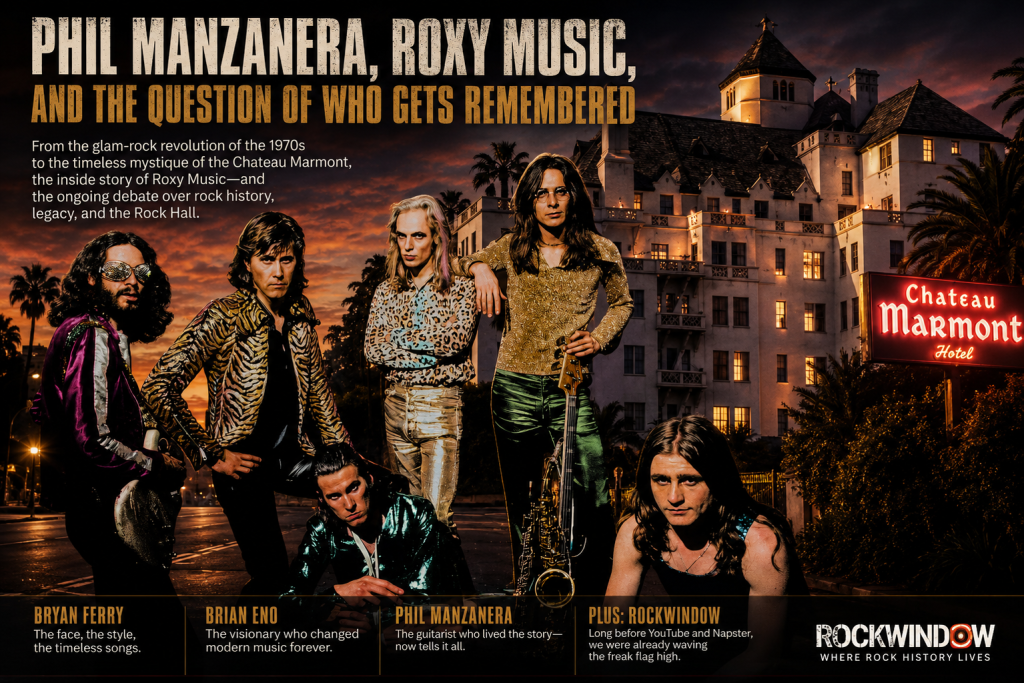
As debates continue over the latest Rock & Roll Hall of Fame induction class, Phil Manzanera’s memoir, Revolución to Roxy, arrives at a fascinating moment in rock history.
For younger music fans, Manzanera may not be an instantly recognizable name. Yet for more than fifty years, his fingerprints have been all over modern music.
As lead guitarist and key songwriter for Roxy Music, Manzanera helped create one of the most influential bands of the 1970s. Alongside Bryan Ferry, Brian Eno, Andy Mackay, and Paul Thompson, he helped forge a sound that would inspire generations of artists ranging from Duran Duran and Talking Heads to U2, Radiohead, and countless others.
In recent interviews promoting his memoir, Manzanera reflects on a remarkable journey that took him from childhood years spent in Cuba, Colombia, and Venezuela to the center of London’s exploding music scene. His story is not simply about fame. It is about creativity, artistic risk-taking, and the collision of cultures that helped shape one of rock’s most original bands.
One of the most fascinating aspects of the book is Manzanera’s description of the creative chemistry that powered Roxy Music.
At the center of the band stood two very different personalities.
Bryan Ferry brought sophistication, style, romance, and songwriting. Brian Eno brought experimentation, technology, and an entirely new way of thinking about sound. Manzanera describes Roxy Music as the collision of these two artistic worlds, with guitarist Phil Manzanera, saxophonist Andy Mackay, and drummer Paul Thompson helping transform those ideas into music.
The combination produced some of the most influential recordings of the 1970s, including “Virginia Plain,” “Do The Strand,” “Love Is The Drug,” “Dance Away,” “More Than This,” “Avalon,” and “Jealous Guy.”
Ferry became one of rock’s most stylish frontmen, often associated with the elegance of Los Angeles’ legendary Chateau Marmont. The famed Sunset Strip hotel attracted everyone from Jim Morrison and Led Zeppelin to Gram Parsons, Neil Young, and Hunter S. Thompson. Its combination of glamour, privacy, and old Hollywood mystique made it a natural fit for Ferry’s sophisticated image.
Eno, meanwhile, would become one of the most influential producers and musical innovators of the modern era. After leaving Roxy Music, he helped shape landmark recordings by David Bowie, Talking Heads, U2, Peter Gabriel, Devo, and many others while pioneering the genre now known as ambient music.
Looking back, Manzanera suggests the magic of Roxy Music was never Ferry or Eno alone. It was the creative tension between them that made the band unlike anything else on the radio.
Yet Manzanera’s memoir raises a larger question that continues to fuel debate among music fans:
Who gets remembered?
The Rock & Roll Hall of Fame remains one of music’s most celebrated institutions, but also one of its most controversial.
The 2026 induction class included Oasis, Iron Maiden, Billy Idol, Joy Division/New Order, Phil Collins, Sade, and Wu-Tang Clan.
Many fans celebrated those choices.
Others continue to ask why artists such as Motörhead, Thin Lizzy, The Smiths, Sonic Youth, Smashing Pumpkins, Phish, and other influential acts remain outside looking in.
The debate is not really about trophies or ceremonies.
It is about preserving history.
Long before YouTube, Napster, social media, streaming services, and music video websites became part of everyday life, independent efforts were already working to preserve rock culture online.
Rockwindow was one of them.
Emerging from my radio career and the freeform spirit of The Freak Show, Rockwindow traces its roots back to the 1980s. Inspired by artists like Jimi Hendrix and the belief that music should never be confined by labels or convention, Rockwindow embraced individuality, creativity, and the stories behind the music.
When Rockwindow launched online in the early 1990s, it arrived years before Napster, years before YouTube, and years before streaming became commonplace.
Before the Rock & Roll Hall of Fame Museum officially opened its doors in Cleveland, representatives connected with the project visited Rockwindow’s California offices. At the time, Rockwindow’s growing circle included legendary freeform radio pioneer Jim Ladd, the inspiration for Tom Petty’s The Last DJ; Rockline host Bob Coburn; Woodstock co-creator Artie Kornfeld; and many other respected voices from the rock community.
As the Hall secured funding and expanded its mission, Rockwindow continued pursuing its own independent path. There was never any animosity—only a shared belief that rock history deserved to be preserved and celebrated.
In fact, one of Rockwindow’s earliest promotional videos ended with a simple message:
“Support the Rock & Roll Hall of Fame.”
That sentiment remains unchanged today.
Whether the discussion centers on Roxy Music, Motörhead, Thin Lizzy, Iron Maiden, or the latest induction class, the goal should be the same:
Keep the music alive.
Keep the stories alive.
Keep the history alive.
Phil Manzanera’s memoir serves as a reminder that some of the most important figures in rock history are not always the most famous.
Sometimes the people who change music forever are standing just outside the spotlight.
And perhaps that spirit is best captured by Jimi Hendrix, whose music inspired generations of outsiders, dreamers, and innovators.
As Hendrix declared in If 6 Was 9:
“Wave my freak flag high.”
More than half a century later, rock and roll is still doing exactly that.
Marcus Hause