By Marcus Hause
My parents loved Las Vegas.
Fortunately for me, they never had a gambling problem.
Mom enjoyed the slot machines. Dad liked a little craps.
If they were winning, great. If they weren’t, it was time
to go home.
Every few months we would pile into the family car and
make the long drive from Los Angeles to
Las Vegas. This was before Interstate 15 became
the high-speed route everybody knows today.
I spent those trips in the back seat reading Archie,
Richie Rich, Batman, and Sad Sack comic books.
But there was one place that always made me put the
comics down.
Joshua Tree.
I can still remember an entrance sign standing beside
actual Joshua trees when it was still known as
Joshua Tree National Monument. Those strange-looking
plants fascinated me. They looked like
something from another world.
Years later the new freeway came, the old drives
faded into memory, and my attention turned to music.
That was when Joshua Tree started appearing again.
Not on a map.
In rock and roll.
I learned that Donovan had spent time in the desert. Jim Morrison was drawn to the Mojave. Artists, musicians,
mystics, UFO hunters, and psychedelic explorers all seemed to find their way there.
There was something about the place.
The silence.
The stars.
The feeling that civilization was a hundred miles away.
No musician became more connected to Joshua Tree than Gram Parsons.
Today Parsons is recognized as one of the founders of country rock, but during his lifetime he was never a major commercial star.
He briefly joined The Byrds and became the driving creative force behind Sweetheart of the Rodeo, an album now considered one of the
most influential recordings in rock history.
His vision was simple but revolutionary.
In the late 1960s, rock and country music were cultural enemies. Parsons believed both forms of music came from the same emotional place.
He blended country, rock, folk, gospel, and rhythm and blues into what he called “Cosmic American Music.”
Without Gram Parsons, there is a good argument that The Eagles, Poco, and much of modern country rock would sound very different.
Ironically, despite his musical genius, Gram’s personal life often resembled a country song.
His biological father committed suicide when Gram was only twelve years old.
His mother later drank herself to death from cirrhosis while Gram was graduating from high school.
Both parents died at just thirty-six years old.
Although he inherited significant family wealth from the wealthy Snively citrus family of Florida, money never seemed to bring him much peace.
Instead, he chased music.
And eventually he found Joshua Tree.
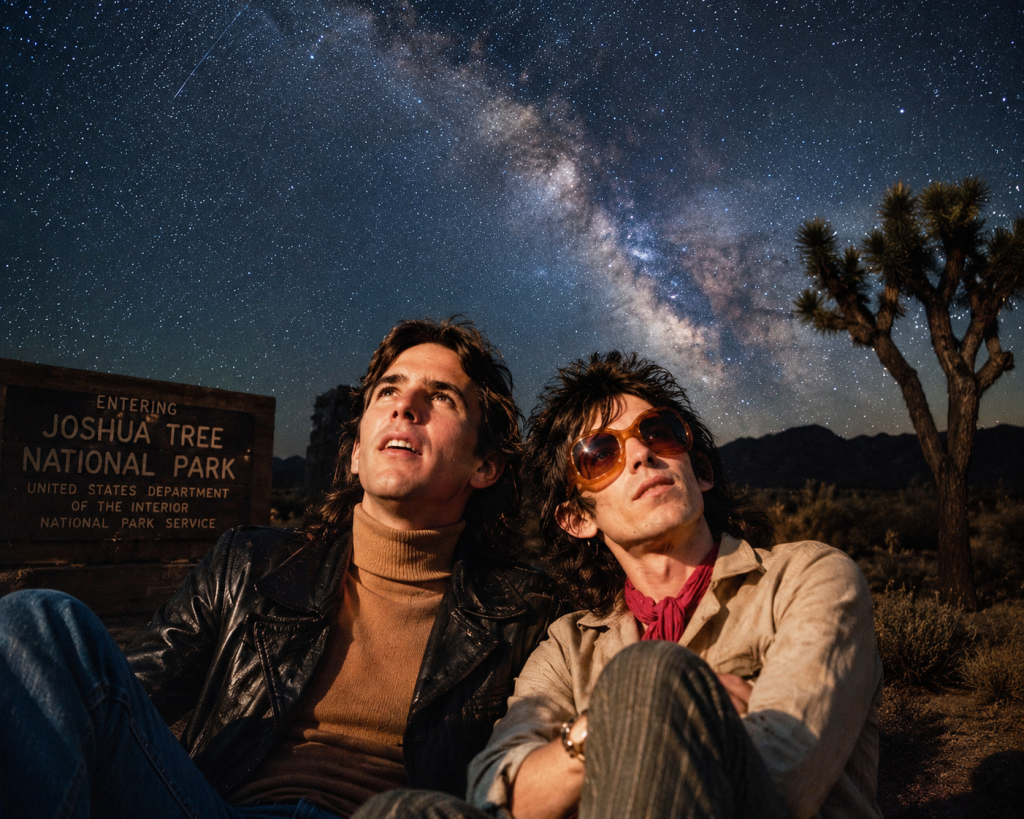
The desert became a sanctuary.
Friends recall weekends spent sitting beneath the stars,
drinking heavily, experimenting with drugs, searching for
UFOs, and talking about life, music, and the universe.
One of those friends was Keith Richards of The Rolling Stones.
Joshua Tree wasn’t simply a place Parsons visited.
It became part of who he was.
In July of 1973, Gram attended the funeral of his
friend Clarence White, the legendary Byrds guitarist who had been
killed by a drunk driver.Looking around at the formal service,
Parsons reportedly turned to his close
friend and road manager
Phil Kaufman and said he wanted something very different.
If he died, he wanted his body taken to Joshua Tree.
No church.
No gloomy ceremony.
Just friends, a few beers, a few laughs,
and a cremation in the desert.
A few months later, Gram Parsons was dead.
He was only twenty-six years old.
What happened next sounds less like rock history
and more like a Hollywood screenplay.
Parsons’ stepfather, Bob Parsons, immediately
became involved in plans for the estate. Gram had died
without a will. According to accounts that emerged later,
the stepfather hoped to establish legal grounds
that could strengthen claims against the inheritance.
Phil Kaufman was furious.
He knew exactly what Gram had wanted.
So Kaufman and Gram’s assistant Michael Martin came up with a plan.
A terrible plan.
A drunken plan.
And one of the greatest rock-and-roll plans ever conceived.
They drove to Los Angeles International Airport where Gram’s
coffin was waiting to be shipped for burial.
Dressed like something out of a low-budget western movie,
they convinced airline personnel
that the family had changed funeral arrangements.
A few signatures later, they had possession of the coffin.
Then they loaded it into a hearse and headed for Joshua Tree.
At Cap Rock, deep in the desert Gram loved, they dragged
the coffin from the vehicle,
poured gasoline over it, and set it ablaze.
The resulting fireball lit up the desert sky.
Campers reported the blaze.
Rangers responded.
Kaufman and Martin fled the scene.
When authorities finally caught up with them,
prosecutors discovered a bizarre legal problem.
California had no specific law covering the theft of a corpse.
Instead of being charged with stealing a body, they were
largely prosecuted for stealing and destroying the coffin.
The punishment amounted to little more than fines.
Meanwhile, the inheritance battle collapsed.
The stepfather’s plans failed.
Despite all the maneuvering, he never gained
control of Gram’s fortune.
The body-snatching scheme had succeeded in
honoring Gram’s wishes while completely disrupting the
plans of those seeking control over his remains.
Today, more than fifty years later, the story has become one of
rock and roll’s most enduring legends.
Part outlaw tale.
Part dark comedy.
Part tragedy.
And somehow perfectly fitting for the man who invented
Cosmic American Music.
Whenever I hear Gram Parsons’ music, I don’t just think
about The Byrds,The Flying Burrito Brothers, Keith Richards,
or Emmylou Harris.
I think about Joshua Tree.
I think about those strange trees I saw as a kid from
the back seat of my parents’ car.
I think about the old road to Las Vegas before the
freeway changed everything.
And I think about how one lonely stretch of California
desert somehowbecame a crossroads for musicians,
dreamers, outlaws, and legends.
Not bad for a place most people simply drive past.