Gonzo Spirit in a Rock ‘n’ Roll World
By Marcus Hause, Rockwindow
I grew up in Westchester, Los Angeles, where the roar of jets from LAX mixed with guitars blasting
from KMET and KLOS. My older brother went to high school with members of The Turtles, and by
the time my folks moved us to Palos Verdes in 1972, I was chasing the LA scene—from the
Troubadour to the Sunset Strip.
I remember wild backyard parties, meeting characters straight out of The Falcon and the Snowman,
and scoring pot like it was a rite of passage. Later, I pursued broadcasting school, dreaming of
being like my hero Jim Ladd—the DJ Tom Petty immortalized in The Last DJ. By 1991, Jim
narrated my first Rockwindow pilot, sharing the stage with Mark Goodman, MTV’s first VJ. By 1992,
I was already using the word “internet” with Rockwindow Television, and by 1999, I raised $1 million
to move Rockwindow into broadband with the help of MTV co-founder Nyhl Henson. We survived
the crash, and Rockwindow still lives today, aiming to be the premier destination for classic and
modern rock online. But in the middle of all this music, another figure loomed large: Hunter S. Thompson.
Hunter and Rock ‘n’ Roll Thompson wasn’t a musician, but he lived like one. He favored Bob Dylan, The Rolling Stones,
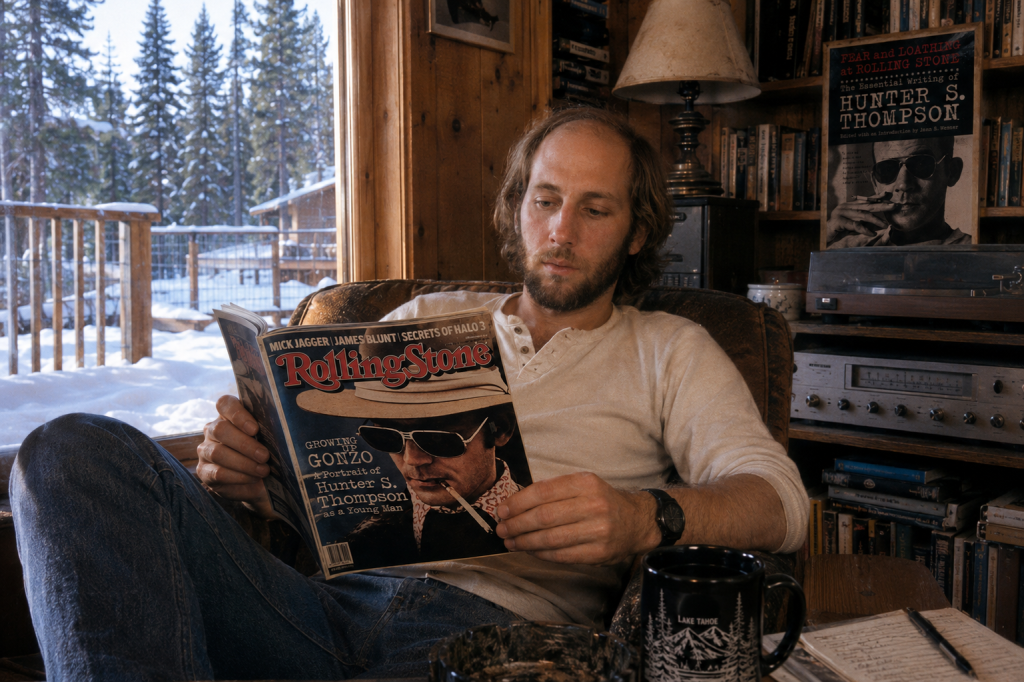
The Grateful Dead, and Jefferson Airplane—bands that defined rebellion. His writing in Rolling Stone
was pure rock ‘n’ roll journalism: loud, chaotic, and impossible to ignore.
Gonzo Journalism Discovered by Jann Wenner, Thompson became Rolling Stone’s national affairs correspondent.
His Fear and Loathing in Las Vegas (1971) and Fear and Loathing on the Campaign Trail ’72 captured
politics with the same energy as a Stones concert. He called it gonzo journalism—where the writer
was inseparable from the story, the drugs were real, and the truth was bent but never broken.
Drugs, Film, and Myth
The LSD tales in Fear and Loathing in Las Vegas were based on real binges with attorney Oscar
Zeta Acosta, though exaggerated for effect. The film adaptation arrived in 1998, directed by Terry
Gilliam, starring Johnny Depp as Raoul Duke and Benicio del Toro as Dr. Gonzo. It flopped at the
box office but became a cult classic, cementing Thompson’s legend for a new generation.
Palos Verdes and Sable Starr
When my family moved to Palos Verdes in the early 1970s, the scene shifted from the Sunset
Strip’s neon chaos to the cliffs overlooking the Pacific. At Palos Verdes High School, I met Sable
Starr—the same Sable who was known as the “queen of the groupie scene” on the Strip. She was
one of my friend’s older sisters, and I heard firsthand her wild Hollywood stories.
After the groupie era faded, she married my best friend and former roommate Jay when we lived
near Lake Tahoe. Her journey from Sunset Strip royalty to quiet Nevada life mirrored the evolution
of rock itself—wild beginnings, hard lessons, and eventual peace.
Last Years in Colorado Thompson spent his final years at Owl Farm in Woody Creek, Colorado.
He was surrounded by hiswife Anita, his son Juan, and close friends like Johnny Depp.
On February 20, 2005, he took his
own life. His ashes were later blasted from a cannon in a private ceremony funded by Depp—a final
gonzo gesture.
Quotable Gonzo
“We were somewhere around Barstow on the edge of the desert when the drugs began to take
hold.”
“I hate to advocate drugs, alcohol, violence, or insanity to anyone, but they’ve always worked for
me.”
Why He’s Still Relevant
Thompson’s distrust of politicians mirrors today’s skepticism about institutions. His gonzo style
paved the way for immersive journalism, blogs, and podcasts.
Closing Thought
For a teenager in 1970s Los Angeles, Hunter S. Thompson was as much a legend as the bands
blasting from KMET and KLOS. He didn’t play guitar, but he shredded the truth with the same
ferocity. His words were riffs, his columns were concerts, and his life was pure rock ‘