Long before Rockwindow, before streaming media, before trying to corral rock legends into interviews and projects, I was in Los Angeles chasing acting gigs, working radio, and driving limousines through the Hollywood Hills. Back then my life felt like one long movie trailer with no ending attached. One week I would be chasing acting jobs, another week behind a microphone, and the next driving through Beverly Hills wondering who would be climbing into the back seat next.
Some weeks it felt like I was living inside my own rockumentary on wheels.
One day I picked up Billy Gibbons.
Not in some little town car either.
I had a full stretch limo.
Now most people would expect a guy who looked like Billy Gibbons to disappear into the back seat behind dark glass like royalty headed to some secret Hollywood summit.
Nope.
Billy Gibbons was sitting up front with me like we were headed to the bait shop.
I drove him all over Los Angeles that day — label meetings, lunch stops, airport runs, and the whole Hollywood loop. Somewhere along the ride he pulled out one of those early cell phones and plugged it into the cigarette lighter in the dashboard.
Back then those things still felt like futuristic technology.
What struck me wasn’t the beard.
The beard had already achieved its own celebrity status.
It was how normal he was.
Billy spent more time asking questions about me than talking about himself.
Meanwhile I was doing what I always did — talking radio, talking ideas, eventually slipping in my early pitch for Rockwindow.
He looked over and said:
“Call me when it gets going.”
Years later I realized there was a lot more sitting beside me than I knew at the time.
I knew Billy was Billy Gibbons. I knew the guitars. I knew the hot rods. I knew the blues swagger and the sunglasses.
But I didn’t know the whole story.
Long before ZZ Top became MTV royalty, Billy’s road into music took some unexpected turns. His father sent him to New York to study percussion under Tito Puente. Not exactly where people expect a future Texas blues guitar giant to begin.
Maybe that’s where some of that rhythm and groove came from.
Then at thirteen he received a Gibson Melody Maker and a Fender Champ amp for his birthday.
Within months he already had his first band.
Some people take years to find their road.
Billy looked like he had already started paving his.
Then came the Hendrix story.
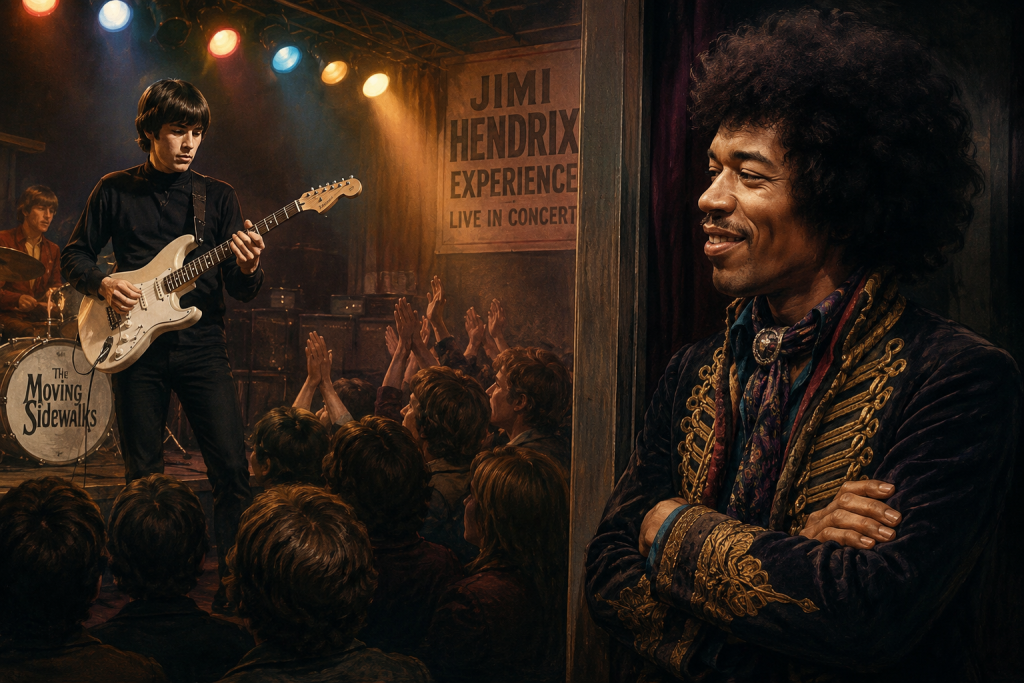
Back in 1968 Billy was with The Moving Sidewalks opening for Jimi Hendrix. They needed extra material to fill their required set and decided to do something that had to feel completely insane:
They played Hendrix songs.
In front of Hendrix.
Imagine being a young guitarist and looking offstage to see Hendrix standing there in the shadows with his arms folded.
Afterward Hendrix reportedly smiled and told Billy:
“I like you. You’ve got a lot of nerve.”
As a Hendrix nut myself, if I had known all of that while driving Billy around in that stretch limo through Los Angeles, I probably would’ve driven right past LAX.
I would’ve started firing questions like machine-gun rounds:
What was Hendrix really like?
Did he laugh a lot?
Did he sit around all night talking music?
Did he know he was changing guitar history while he was doing it?
And then there were the cars.
Billy Gibbons didn’t just love hot rods — he practically became part of American hot rod culture itself. ZZ Top videos helped turn customized cars into rock stars. The Eliminator coupe became almost as famous as the band. Billy always seemed to understand something Hollywood eventually learned too:
Cars, guitars, attitude, and mystery all belonged together.
Funny how life works.
Years later Nyhl Henson would tell stories about the early cable days and the type of artists he felt belonged in television’s visual frontier — cars, guitars, girls, and country-rock blues.
In Nyhl’s view, ZZ Top fit naturally into that world.
Now here’s the Rockwindow Reality Check.
For years Nyhl never seemed interested in planting flags or taking victory laps. He wasn’t running around saying, “I invented this” or “that was me.”
Maybe that’s why a lot of people outside the room never heard the story.
But eventually enough people begin taking credit that somebody has to straighten out parts of the record.
Nyhl Henson wasn’t standing outside watching the early cable revolution happen.
He was helping build it.
Nyhl oversaw portions of the early QUBE project and helped develop programming concepts that pushed television toward places nobody fully understood yet.
One of those projects was PopClips, developed with Michael Nesmith, who had already been experimenting with visual storytelling through Elephant Parts.
Today people pull out a phone and watch music videos while waiting in line for coffee.
Back then the idea of sitting around simply watching music videos was almost a foreign concept.
Programs like PopClips helped prove audiences would actually do it.
And from the Rockwindow editorial side:
Without the people experimenting with those early concepts, MTV may not have looked like the MTV we remember.
Maybe not at all.
Then again, history has a funny way of working.
You think you’re just driving a guy around Los Angeles.
Then years later you realize you had been sitting beside someone carrying around pieces of rock-and-roll mythology.
Billy Gibbons turned out to be one of rock’s biggest legends.
The funny part was that one of rock’s biggest legends spent the whole day riding shotgun beside me like we’d known each other for twenty years.