By Marcus Hause
There may not be another man in American music whose fingerprints ended up all over rock and roll without ever really becoming a rock star himself.
Today, the recent film A Complete Unknown has put Bob Dylan and Woody Guthrie back into the spotlight. The movie starring Timothée Chalamet generated major buzz and was nominated for eight Academy Awards including Best Picture and Best Actor, yet after all the attention and buildup it walked away empty-handed on Oscar night.
Maybe that’s fitting in a strange way.
Because the bigger story was never really Hollywood.
The bigger story may be the man who quietly changed American music without ever becoming a traditional rock star himself.
Woody Guthrie.
For most of us in elementary school, we probably knew him long before we knew his name.
“This Land Is Your Land…”
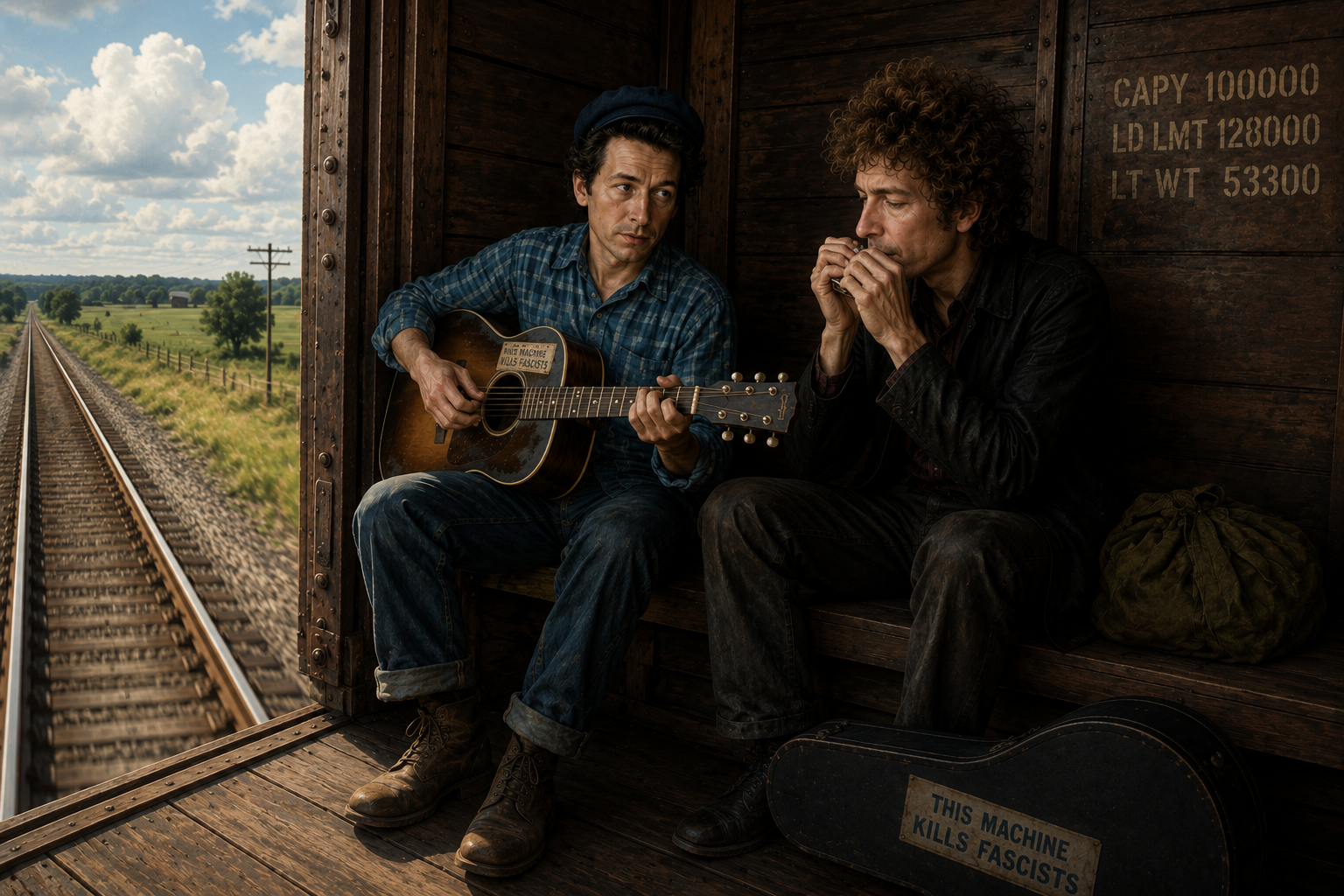
We sang it in classrooms without realizing we were singing the work of a man who once rode freight trains, wandered America during the Depression, and carried a guitar with the now-famous words:
“This Machine Kills Fascists.”
Most people know the chorus.
Far fewer know the story behind it.
In the winter of 1940, Woody became frustrated hearing God Bless America playing repeatedly on the radio. To Woody it sounded too comfortable and too polished compared to what he was seeing around him.
America was hurting.
Families were leaving their homes.
Workers struggled.
People traveled across the country looking for any opportunity they could find.
So Woody decided to fight music with music.
Sitting in a cheap New York City hotel room, he wrote what would eventually become one of the most recognized songs in American history:
This Land Is Your Land.
Ironically, some of Woody’s more political verses questioning inequality and private property disappeared from school books over the years.
Woody’s influence spread far beyond folk music.
Peter, Paul and Mary helped carry Woody’s music into a new generation and performed This Land Is Your Land, introducing millions of listeners to his work. Young musicians absorbed Woody’s storytelling style and passed it on again.
Then came a young musician from Minnesota.
Bob Dylan had read Woody’s autobiography Bound for Glory and became obsessed with finding him. Dylan eventually traveled east to New York looking for his hero.
The recent film recreated Dylan’s emotional visits with Woody during Woody’s battle with Huntington’s disease. The larger story is true. Dylan really did visit Woody regularly during his later years. Hollywood appears to have compressed and dramatized some of the details, but the passing of the musical torch itself was real.
Woody Guthrie.
Bob Dylan.
Folk rock.
Classic rock.
One generation handing a guitar to the next.
Meanwhile, Woody’s own family was living through another story.
His wife Marjorie Guthrie carried much of the burden during Woody’s illness while a young Arlo Guthrie grew up surrounded by guitars, songs, and stories.
Arlo eventually stepped into a very different world.
Rock and roll had exploded.
Woodstock had arrived.
And Arlo carried pieces of his father’s storytelling style into a new era.
The first time I ever heard the word “keys” had nothing to do with music.
I remember our next-door neighbor opening her daughter’s closet and showing my mother a key of cannabis hidden inside.
Then, not long after, there was Arlo singing about bringing in “a couple of keys” to Los Angeles at Woodstock.
Funny how words circle back around.
And songs do too.
Years later, I was traveling by train from New Hampshire back toward California when Nyhl Henson called. Nyhl Henson was one of the overlooked early architects behind MTV who never got enough credit for helping shape the network’s early direction. He said he was visiting his old family farm near Orchardville and told me I should stop in Illinois.
I changed trains in Chicago and watched the doors close right in my face.
Gone.
Amtrak basically told me I was out of luck.
I called back and explained my stroke situation and somehow managed to get myself on another train the next day.
Then Nyhl sent me an Arlo Guthrie song:
City of New Orleans.
As I rolled through Illinois, I hit play.
“Riding on the City of New Orleans…”
“Illinois Central rolling past houses, farms and fields…”
Outside the train window there they were.
Houses.
Farms.
Dark fields moving by in the middle of the night.
Suddenly I wasn’t listening to the song anymore.
I was inside it.
Nyhl picked me up around three in the morning. I thought I would stay one or two nights.
I stayed three years.
The next day I attended his sister’s funeral, and eventually that unexpected stop became a chapter in my upcoming book Deadchester.
Funny thing about Woody Guthrie.
He wrote songs about roads, trains, ordinary people, and unexpected turns in life.
Maybe that’s why his music still works.
Sometimes the song isn’t playing for you.
Sometimes you’re living inside it.
“Passin’ trains that have no names…”
— Marcus Hause